
LeoVegas Trust: Licence, Safety and Safer Gambling
 Available in US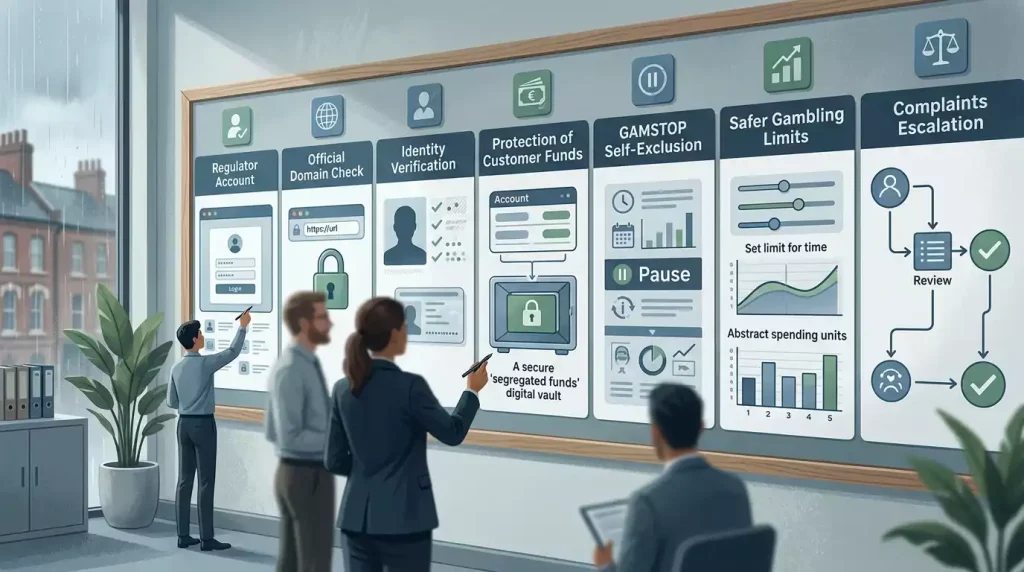
LeoVegas UK trust at a glance
LeoVegas Gaming PLC holds Gambling Commission operator account 39198 with an active remote casino licence (reference 039198-R-319450-028, active from 1 November 2014), an active remote bingo licence (active from 26 February 2018), an active remote real-event betting licence (active from 29 April 2016) and an active remote virtual-event betting licence (active from 23 April 2025). The UKGC domain register lists leovegas.co.uk as the active UK-facing domain for that account; leovegas.com appears as an inactive entry. LeoVegas Gaming plc also holds an MGA licence under MGA/CRP/237/2013 for B2C services, which sits outside the UK licensing path but is sometimes referenced on legal pages.
Licensing is regulatory information, not a personal guarantee. It supports a UK-facing review of the brand, but it does not promise that every reader can register, deposit, withdraw, win or avoid account checks. The sections below combine licence, customer-funds protection, KYC, GAMSTOP, safer-gambling tools, advertising rules and complaint routes into a single trust map, and link out to the deeper pages where each topic has its own caveats. For the wider account decision, the main LeoVegas UK review sits one step up.
The core licence record
The licence record on the Gambling Commission public register is the single most useful trust artefact for a UK reader. The figures below are the headline entries for LeoVegas Gaming PLC and can be cross-checked on the register at any time.
- Operator account number: 39198.
- Operator entity: LeoVegas Gaming PLC.
- Casino remote licence: 039198-R-319450-028, active from 1 November 2014 to current.
- Bingo remote licence: active from 26 February 2018 to current.
- Real-event betting remote licence: active from 29 April 2016 to current.
- Virtual-event betting remote licence: active from 23 April 2025 to current.
- Official UK-facing domain: leovegas.co.uk, listed as active in the UKGC domain registry under account 39198.
- Inactive domain entries: leovegas.com and www.leovegas.com appear as inactive for this account.
- MGA licence (non-UK context): LeoVegas Gaming plc under MGA/CRP/237/2013 for B2C services.
What the licence proves and what it does not
| The licence record proves | It does not prove |
|---|---|
| LeoVegas Gaming PLC is a UKGC-licensed operator under account 39198. | Every UK reader will be allowed to open an account, deposit or withdraw. |
| leovegas.co.uk is the active UK-facing domain for that account. | Any other domain bearing the name is operated by LeoVegas under UKGC terms. |
| Remote casino, bingo, real-event betting and virtual-event betting licences are active. | Every promotion or product is available to every account at every moment. |
| Customer funds are segregated at the UKGC’s medium protection level. | Individual gambling-account balances are insured under the Financial Services Compensation Scheme. |
| The operator must follow UK age and identity verification rules. | Verification will be instantaneous or that documents are never requested at later stages. |
| The operator participates in GAMSTOP, the UK national self-exclusion scheme. | A self-excluded account can be reopened during the exclusion period. |
Eligibility and access caveats
The licence record sets the regulatory baseline, but several access conditions sit on top of it. Account holders must be aged 18 or over, located in the United Kingdom under LeoVegas terms, verified for age and identity before gambling and not subject to any current self-exclusion. Payment-method ownership rules block third-party funding, and the credit-card restriction applies to wallets backed by a credit card as well as to direct card deposits.
None of those caveats is unusual for a UKGC licensee; the combination is what shapes whether a specific reader can actually use the account. The registration and KYC checks page covers the documents and the stage at which each check can fire.
Customer funds protection and payment safety
LeoVegas’s customer funds segregation meets the Gambling Commission’s medium customer-funds protection requirement. Medium protection is a structural arrangement disclosed in the operator’s terms: customer funds are held in accounts separated from operating capital and with arrangements that should ensure repayment in the event of insolvency, although the level of legal certainty is below the highest “high” tier on the UKGC scale. Importantly, this is not the same as full deposit insurance: individual gambling-account balances are not covered by the Financial Services Compensation Scheme.
For the cashier itself, the payment methods page covers the accepted methods, ownership rules and credit-card restriction; the withdrawal page covers limits, fees and the 1-3 business day post-approval window. Payment safety is most effective when read alongside KYC: a verified account and a matching payment method together produce the cleanest payout path.
Safer-gambling tools available on the LeoVegas UK account
The full safer-gambling toolset documented on the official LeoVegas UK help pages is built into every account and accessible from the account menu.
- Spend limits. Available on daily, weekly or monthly bases. Decreases take immediate effect; increases involve a 24-hour wait and a separate confirmation step.
- Loss limits. Cap losses across a chosen period rather than total spend.
- Wagering limits. Cap total stake placed regardless of outcome.
- Session limits. Cap continuous play time; the account locks once the limit is reached for the period.
- Reality checks. Pop-up reminders at chosen intervals: 15, 30, 60 or 90 minutes.
- Time-outs. Lock the account for between 24 hours and 6 weeks.
- Self-exclusion. Lock the account for between 6 months and 5 years across the listed LeoVegas Gaming PLC sites.
- GAMSTOP. The UK national self-exclusion scheme covers every UKGC-licensed online operator. All gambling businesses must participate.
Limits set before play are more effective than limits reached for during a session. The reality-check timer is particularly useful for long live-casino or bingo sessions because both formats can run on longer cycles than a slot spin.
Great Britain wording and the Northern Ireland caveat
The Gambling Commission regulates remote gambling offered to consumers in Great Britain. The Gambling Act 2005 covers England, Wales and Scotland; Northern Ireland has separate gambling arrangements, and the UKGC does not regulate remote-gambling provision in Northern Ireland in the same way. Casual “UK-wide” wording can therefore overstate the regulatory position; the safer wording is “Great Britain” when describing the UKGC framework.
For LeoVegas UK content, the practical reading is that licence, domain and rule references should attach to Great Britain regulation where possible, while still using “UK” for the practical user experience. The winnings and tax page sits inside the trust cluster and carries its own GB/NI caveat for HMRC wording.
Current regulatory changes that affect trust wording
Several recent or upcoming UK rule changes shape how operators, including LeoVegas, frame trust copy. They are worth flagging because they affect what a reader should expect to see on the account.
- Online-slots stake limits (April-May 2025). £5 per spin for adults aged 25 and over, £2 per spin for adults aged 18-24, applied to online slots at UKGC licensees.
- Financial vulnerability checks (August 2024, then February 2025). Light-touch checks at £500 net deposits per rolling 30 days from August 2024, lowered to £150 from February 2025.
- Incentive rules (19 January 2026). Licence Conditions and Codes of Practice changes that limit wagering requirements and ban mixing gambling products inside a single incentive.
- Updated under-18s advertising guidance (October 2025). CAP and BCAP guidance on strong appeal to under-18s in gambling advertising.
- Gross deposit-limit requirements (effective 30 September 2026). Gambling systems will need to offer gross deposit limits across 24-hour, 7-day and one-month periods.
Several of these are forward-looking and will reshape the limits and incentive copy on the LeoVegas UK account between now and the end of 2026. Trust wording on regulatory topics should be refreshed periodically against the live position rather than treated as static.
Support and complaint routes
The standard route for any account issue starts with LeoVegas customer support, accessible from the account menus on web and mobile. The operator is required to respond within a reasonable time and to provide an internal complaints procedure documented on its terms pages. If the internal route does not resolve the matter, LeoVegas signposts an Alternative Dispute Resolution provider as required under UK rules; that provider is independent of the operator and offers a free service to the customer.
Above the ADR layer sits the Gambling Commission itself. The UKGC does not arbitrate individual disputes but does collect information that feeds into compliance activity against operators. Any complaint about underage gambling, marketing compliance or licence-condition breaches can be raised with the Commission directly. For problem gambling support outside the dispute process, GamCare and the National Gambling Helpline provide independent help across the UK.
How trust connects to game categories
Trust caveats run across every game category. Slots, live casino, jackpots and bingo each have their own rule structure, but they all sit under the same licence, the same KYC framework and the same safer-gambling toolset. The games overview page covers the wider category map; the bingo and Slingo category sits inside the same regulated account and benefits in particular from session and reality-check limits because the format draws longer continuous play.
Practical trust checklist before relying on a claim
- UKGC public register search for “LeoVegas Gaming PLC” or account 39198 returns active licences.
- The domain in the browser bar is leovegas.co.uk, listed as active for the account.
- Customer-funds protection wording reads “medium” in the LeoVegas terms.
- Age and identity verification cleared on the account; no pending document request.
- Payment-method name matches the verified account holder; no third-party funding.
- Personal limits set on the account before play.
- GAMSTOP status checked before any new registration attempt.
- Awareness that complaint escalation runs operator support → ADR provider → UKGC.
Licence and safety questions
Is LeoVegas licensed by the UKGC?
Yes. The Gambling Commission lists LeoVegas Gaming PLC under operator account 39198, with active remote casino, bingo, real-event betting and virtual-event betting licences.
What is the LeoVegas UKGC licence number?
The remote casino licence reference is 039198-R-319450-028, active from 1 November 2014 to current, under operator account 39198.
Are customer funds protected at LeoVegas?
Customer funds are segregated and meet the Gambling Commission”s medium protection requirement. This is a structural separation, not deposit insurance; individual gambling balances are not covered by the Financial Services Compensation Scheme.
Does LeoVegas participate in GAMSTOP?
Yes. GAMSTOP is the UK national self-exclusion scheme, and every UKGC-licensed online operator participates. A current GAMSTOP self-exclusion blocks new account registration.
What safer-gambling tools are available?
Spend, loss, wagering and session limits, reality checks at 15, 30, 60 or 90 minutes, time-outs from 24 hours to 6 weeks, and self-exclusion from 6 months to 5 years across LeoVegas Gaming PLC sites.
How do I complain about LeoVegas?
Start with the LeoVegas customer support route documented on the account. If unresolved, escalate to the Alternative Dispute Resolution provider LeoVegas signposts, then to the Gambling Commission for licence-condition concerns.
Verify the licensing status of major online bookies on the homepage.
Learn about player rights and tax exemptions by reading our guidance on taxation of winnings.
Recommend
Written by the editors at Leo Casino UK.